Reliable gas supply, expert advice and outstanding service across Hampshire, West Sussex and the South Coast since 1999.
Industry Experience
Run Business
Delivery Fleet
Businesses
Rapid Industrial Gases supplies welding gases for fabrication, engineering, automotive repairs, manufacturing, construction and general workshop use.
Established in 1999, we support welders and businesses across Portsmouth, Hampshire, West Sussex and the surrounding areas with dependable gas supplies, knowledgeable advice and a reliable local delivery service.
Whether you are welding mild steel, stainless steel, aluminium or another specialist material, our experienced team can help you choose the right shielding gas and cylinder size for your equipment and application.
The gas used during welding plays an important role in the quality, strength and appearance of the finished weld.
Choosing the correct gas can help to:
The most suitable option will depend on the welding process, material, thickness and desired result.
Speak to our team for practical advice on selecting the right welding gas for your requirements.
MIG and MAG welding are widely used across fabrication, engineering, automotive and manufacturing environments.
These processes use a continuously fed wire electrode, together with a shielding gas that protects the weld area from the surrounding atmosphere.
The best shielding gas will depend on the metal being welded and the type of finish required.
Argon and carbon dioxide mixtures are commonly used for welding mild and carbon steels.
The argon helps provide a stable arc and smoother weld, while the carbon dioxide supports penetration.
Depending on the mixture selected, benefits may include:
Different gas mixtures are available to suit varying material thicknesses and welding conditions.
Pure carbon dioxide can be used for MAG welding mild steel.
It can provide good penetration and may be suitable for certain heavy-duty or cost-conscious applications. However, it can produce more spatter and a less stable arc than an argon-based mixture.
Our team can advise whether pure carbon dioxide or a mixed shielding gas is better suited to your work.
Pure argon is commonly used for MIG welding non-ferrous materials, including aluminium.
It provides effective shielding and supports a smooth, stable arc when used with appropriate equipment and welding settings.
TIG welding is often chosen where precision, control and a high-quality finish are important.
It is commonly used for:
Pure argon is the most commonly used shielding gas for TIG welding.
It helps create a stable arc, provides effective protection from atmospheric contamination and supports clean, controlled welds.
Argon is suitable for many TIG applications, including welding stainless steel, mild steel and aluminium.
Some TIG welding applications may benefit from specialist argon-based gas mixtures.
These can be used to improve heat input, welding speed, penetration or arc characteristics when working with particular materials.
Please contact us with details of your welding process and material so we can advise on suitable availability.
Mild steel is commonly welded using MIG, MAG or TIG processes.
For MIG and MAG welding, an argon and carbon dioxide mixture is often selected because it provides a good balance between arc stability, penetration and weld appearance.
Pure carbon dioxide may also be suitable for some mild-steel applications where deeper penetration is required and additional spatter is acceptable.
For TIG welding, pure argon is commonly used.
Stainless steel requires careful shielding to protect the weld and maintain a clean finish.
Pure argon is widely used for TIG welding stainless steel, while specialist argon-based mixtures may be selected for MIG or MAG welding.
Using the correct gas can help reduce oxidation, control the arc and improve the overall appearance of the weld.
Aluminium is commonly welded using MIG or TIG equipment with pure argon shielding gas.
Argon provides stable shielding and helps produce a smooth arc and clean weld.
The correct gas flow, equipment setup and surface preparation are particularly important when welding aluminium.
Rapid Industrial Gases also supplies gases used for oxy-fuel welding, cutting, brazing and heating.
Oxygen supports combustion and is used with a suitable fuel gas to create the high temperatures needed for cutting, welding, brazing and heating metal.
Acetylene produces a very hot and concentrated flame when combined with oxygen.
It is commonly used for precision welding, cutting, brazing and heating applications.
Propane can be used with oxygen for heating, brazing and certain cutting applications.
It is widely used by contractors, roofers, fabricators and other trades requiring a portable fuel gas.
Our team can help you identify the most appropriate gas for your oxy-fuel equipment and intended use.
When selecting a welding gas, several factors need to be considered.
These include:
Using the wrong shielding gas can affect arc performance, increase spatter and reduce weld quality.
Rapid Industrial Gases can provide straightforward advice based on your equipment and application.
We supply welding gases in a range of cylinder sizes to suit different customers and usage levels.
Smaller cylinders may be suitable for:
Larger cylinders may be more appropriate for:
Our team can help you choose a cylinder size that provides sufficient capacity without creating unnecessary storage or manual-handling difficulties.
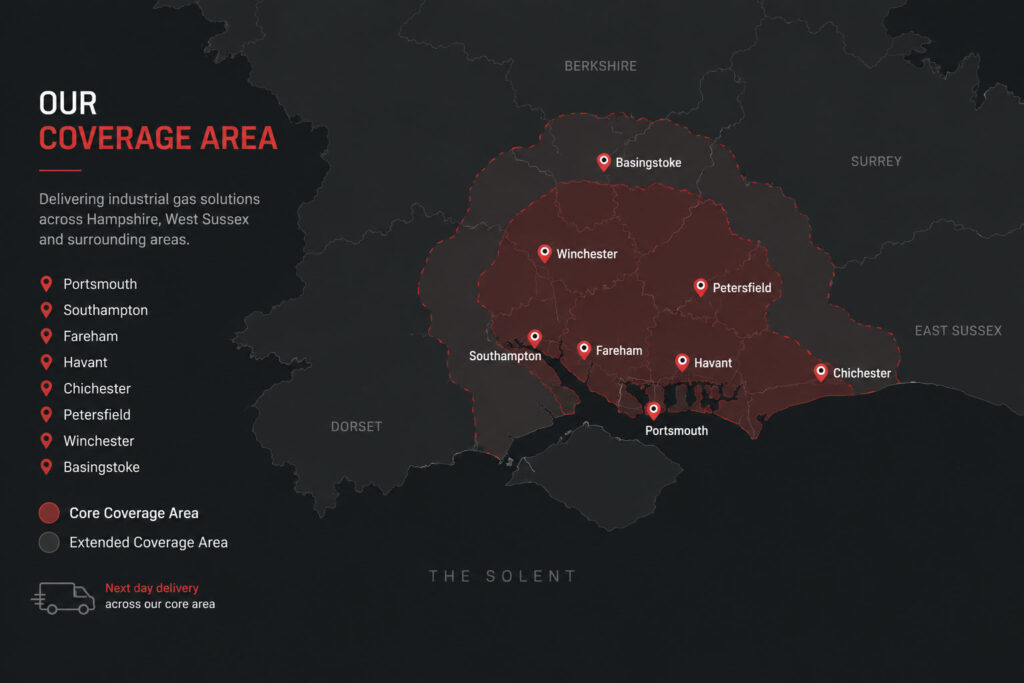
Rapid Industrial Gases provides gas cylinder deliveries throughout Portsmouth, Hampshire, West Sussex and surrounding locations.
Our regular delivery area includes:
If your location is not listed, please contact us. Our team will confirm whether we can arrange delivery or recommend the most convenient collection option.